
WASHINGTON — An offhand comment by President Trump threatening to attack Colombia, a major U.S. ally, has roiled its government and confounded its public, anxious and unsure whether to take the U.S. leader seriously.
Trump’s remarks came during questions from reporters Tuesday over a prospective U.S. military campaign against drug trafficking networks in Latin America. The mission could expand beyond Venezuela, the prime target of nascent U.S. war plans, the president said.
“I hear Colombia, the country of Colombia, is making cocaine,” Trump said at a Cabinet meeting. “Then they sell us their cocaine. We appreciate that very much, but yeah, anybody that’s doing that and selling it into our country is subject to attack. Not just Venezuela.”
Gustavo Petro, Colombia’s first leftist president, who has repeatedly clashed with the White House, likened Trump’s bellicose rhetoric to a declaration of war.
“Do not threaten our sovereignty, because you will awaken the Jaguar,” Petro wrote on X. “Attacking our sovereignty is declaring war; do not damage two centuries of diplomatic relations.”
In an official communique, the Colombian Foreign Ministry called on “brotherly” nations in Latin America and the Caribbean to reject “any attempt at foreign intervention that seeks to undermine sovereignty.”
Trump’s latest threat comes amid deteriorating relations with Bogota, which celebrated 200 years of diplomatic relations with Washington just three years ago and, marking the occasion, was designated a major non-NATO ally by President Biden, a status celebrated across party lines on Capitol Hill.
Petro’s election that year began a shift, with U.S. assistance reduced in 2024 over Petro’s drug policies and, at the beginning of this year, paused completely by the Trump administration. The Treasury Department labeled Petro an “illegal drug dealer” in October and imposed sanctions against him and his family.
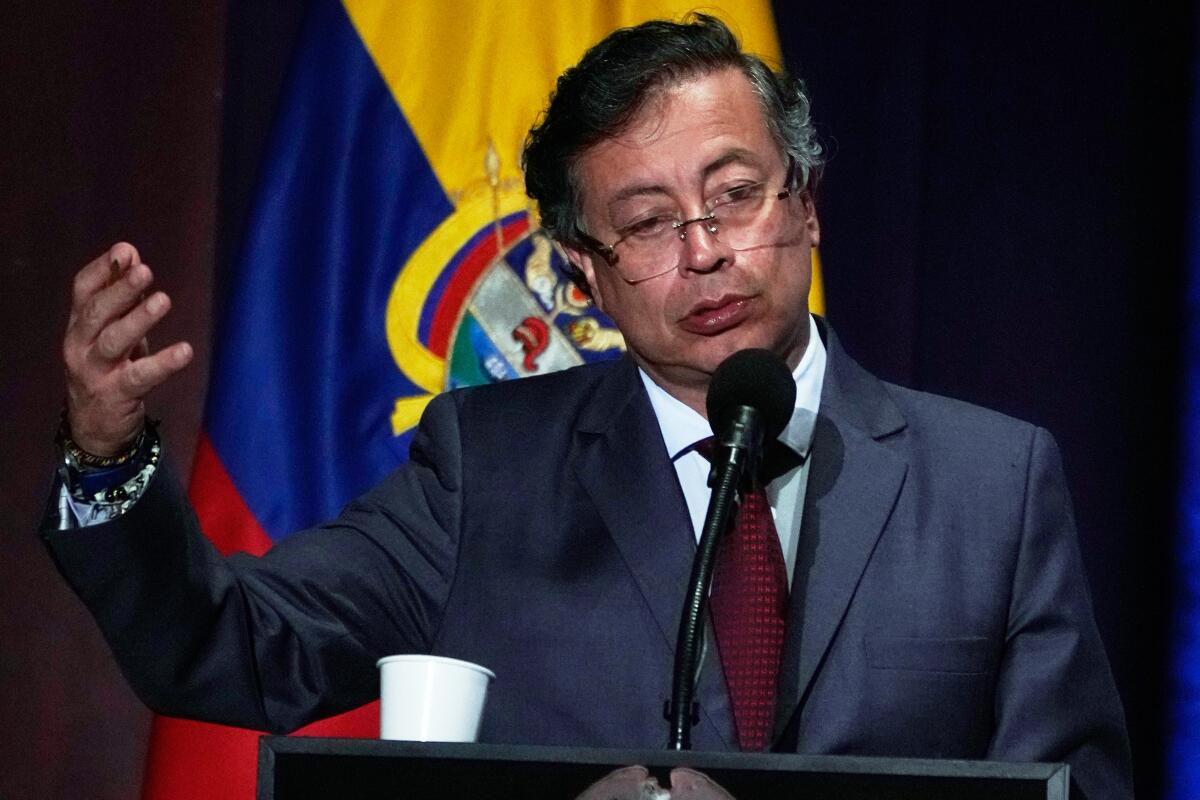
Colombian President Gustavo Petro has been a harsh critic of President Trump.
(Fernando Vergara / Associated Press)
Evan Ellis, who served in Trump’s first term planning State Department policy on Latin America, the Caribbean, and international narcotics, told The Times that strikes against Colombia are unlikely — but not as far-fetched as the prospect of a U.S. attack on Mexico, whose economic clout is greater, and whose government has fared better in diplomacy with Washington.
“There’s a strong hope that it’s just bluster — that, given Colombia has a sovereign government that the U.S. recognizes and has long worked with, it’s understood it would be catastrophic for the relationship,” Ellis said. “There’s a combination of concern and confusion, but there is a hope that this is just part of the president’s style.”
Trump’s secretary of State, Marco Rubio, and deputy secretary of State, Christopher Landau, both have deep knowledge of the region and are said to be advocating against military strikes against U.S. allies. But Petro’s insults against Trump, calling him “ignorant,” “profoundly rude” and “against humanity,” have rankled a U.S. president accustomed to obsequious praise.
“In a certain way, despite the close military relationship and everything at stake, you clearly have a president who’s been imprudent at best,” Ellis said of Petro. “Making shrill and defiant statements against Trump are about the clearest way to get on his bad side.”
United Nations figures show that Colombian cultivation of coca — the raw ingredient in cocaine — has reached record levels in recent years, fueled by rising demand for cocaine not only in the United States, but also Europe and elsewhere.
Whereas U.S.-Venezuelan relations have been strained for more than a quarter of a century, Colombia has long been viewed as a steadfast ally, receiving billions in aid from Washington destined for antidrug campaigns. The alliance has endured despite large-scale internal strife in Colombia and the nation’s status as the world’s primary producer and exporter of cocaine.
The specter of a U.S. military attack seemed unfathomable to many Colombians processing the news Wednesday.
“A few years ago, we would never have imagined that Colombia could be threatened with attacks on its territory,” said Sebastián Bitar, an analyst at the University of the Andes. “We trusted in the solid relationship between the United States and Colombia.”
Guillermo Cochez, a Panamanian politician who served as his nation’s ambassador to the Organization of American States, believes that Trump’s threat against Colombia amounts to bluster, noting close ties between U.S. Southern Command and the Colombian military. “The most Americanized military in Latin America is the Colombian military,” Cochez told The Times.
“The United States will not do anything in Colombia, because they have to solve Venezuela first. That will be happening in the next phase,” Cochez said.
“Petro has so many problems inside Colombia that is known by the American government,” Cochez added. “It’s a distraction for Donald Trump. He’s trying to use his fight with Trump to try to get some respect in Colombia.”
The armed forces of the two nations have collaborated for years, conducting joint training exercises and counter-narcotics operations. A unilateral strike could upend that relationship, wrote the Colombian daily El Heraldo in an editorial, warning a U.S. attack could spark an “unprecedented regional reaction, with internally displaced [civilians], retaliations by various actors, border crises and new diasporas.”
Throughout Latin America, Trump’s saber-rattling has alarmed many — especially on the left — reflecting the region’s historic wariness of U.S. intervention.
Alejandro Rusconi, a left-wing Argentine lawyer and analyst, called Trump’s statements “yet another demonstration of the belligerent escalation being carried out by the U.S. government against the peoples of Latin America and the Caribbean.”
But many local analysts warned that Colombia needed to heed Trump’s threat, taking whatever steps are necessary to avoid a direct confrontation.
“Its not the time to provoke the United States,” economist Mauricio Reina told Red Más Noticias, a Colombian outlet.
“With Donald Trump,” he added, “one has to fly low, avoiding the radar.”


